Your estate is mostly fine.We find the bit that isn’t.
Planetic reads the data your buildings already produce, checks it against the standards you’re held to, and turns the problem into a job — sent to the right person, and chased until it’s closed.
Same pattern. Every building type.
Over the years we’ve used IoT to monitor offices, heritage estates, warehouses, hospitals, cold storage, care homes, social housing, hospitality venues, casinos, and schools. The pattern doesn’t care what the building is for: heating systems run when rooms are empty, cooling stacks chill space nobody uses, ventilation runs against schedules that haven’t been right in years. The walls and the calendar disagree. The sensors caught it every time.
What we found is that monitoring isn’t enough. Better data, no extra hands to act on it. We were loading customers with more problems than they could fix.
Planetic is the result of that experience.
Configured by the room it's in
A bedroom isn't a kitchen isn't a plant room. Each sensor knows where it lives — and what 'good' means there.
Picked by the building type
School → BB101. Care home → HTM. Social housing → Awaab's Law. The right rulebook is applied automatically.
The orchestration layer
Smart rules, AI judgement, automated flows. Planetic reads the building, applies the standard, and gets the task given, sent, chased and closed.
In most cases this isn’t a cost. It’s using the resource you needed anyway. No overheating. No drive-by maintenance. First-time fix stops being a slogan and becomes the default.
Three ways the building pays you back.
Three places a building quietly leaks money — and what Planetic does to stop each one.
Heat the rooms in use, not the empty ones
Smart valves on the radiators you already have control each room on its own. The occupied classroom gets heat; the empty store cupboard doesn't. No new boiler, no rewiring.
Smart radiator valves (eTRVs)The boiler runs to the real timetable
Not a timeclock nobody has touched in years. Heating follows when people actually arrive, eases off at weekends, and stops costing £400 a day over half-term.
Boiler controlFaults get caught in hours, not at year-end
A stuck valve or a drifting set-point is flagged the day it happens — not three months later when the gas bill lands. The waste stops before it adds up.
Continuous fault alertsOne platform. Three regulations. One audit trail.
Most platforms cover one of these. We cover all three because most of our buyers carry all three on their statutory register.
Legionella
Continuous outlet-by-outlet temperature evidence. Replace clipboard log sheets with a live audit trail. ACOP L8-aligned.
L8 · HSG274Damp & Mould
Continuous humidity, temperature and dew-point evidence per dwelling. Catch the conditions before the complaint arrives.
Awaab's Law · HHSRSExcess Cold & Heat
Continuous internal temperature evidence per occupied space. Schools, social housing, healthcare estates — under one bar.
HHSRS Phase 2 · BB101 · CIBSE TM52Not a slide. The product.
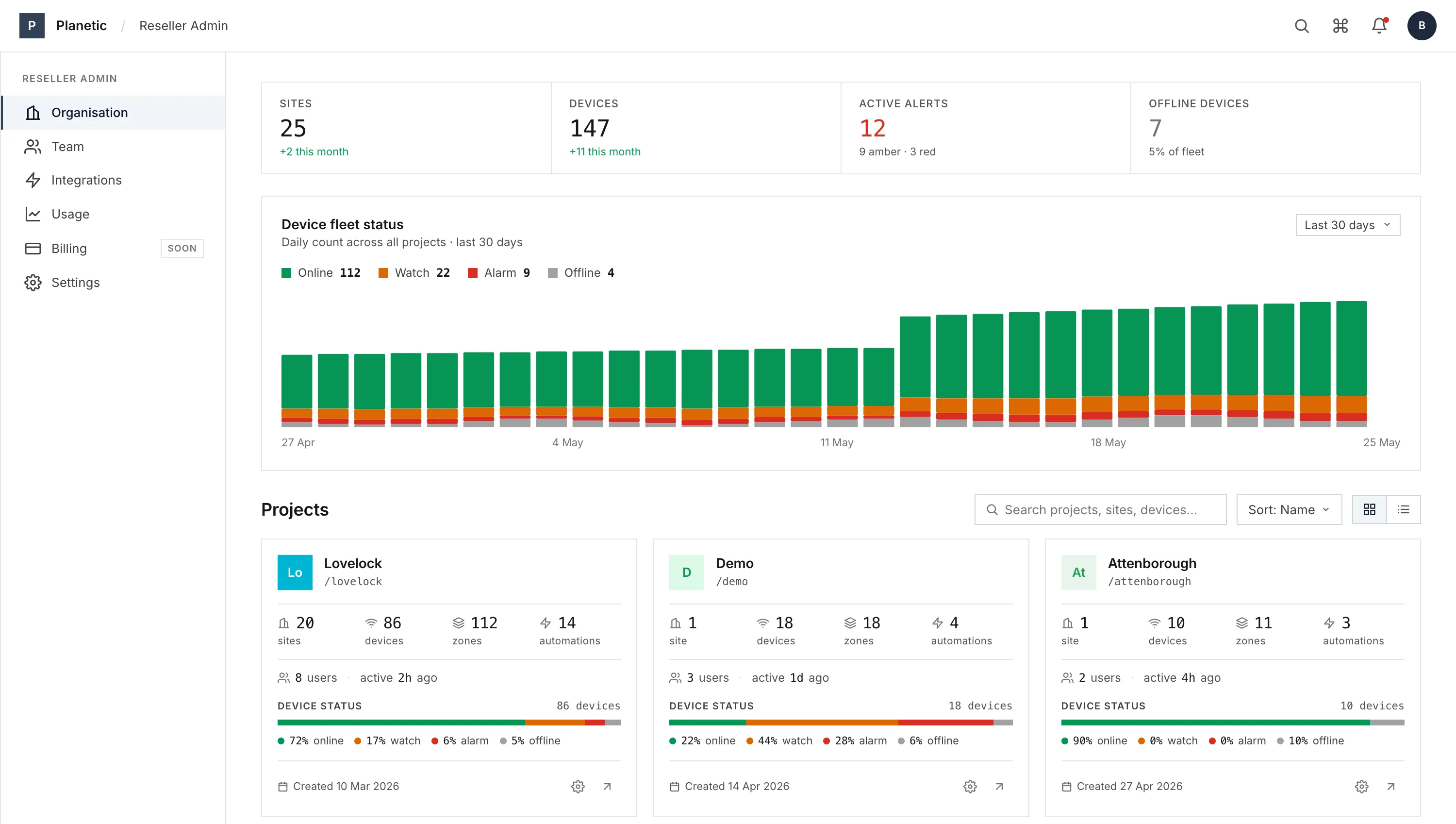
Continuous sensor data, mapped to the rulebook for each room, queued as tasks for the person who can act on them. Nothing here is a mockup.
Sensor to evidence, in six stages.
Same sensor data. The room decides what ‘good’ looks like. The system decides what to do about it. The people see exactly what they need.
Sense
Sensors in every room — temperature, CO₂, humidity, occupancy, damp, energy.
Field layerCarry
LoRaWAN gateways and LNS — kilometres of range, a decade of battery.
TransportIngest
Cloud webhook plus payload decoders. Raw bytes become structured readings.
PipelineContext
Standards plus zone type plus customer dial → RAG. The reading carries the rulebook.
The differentiatorOrchestration
Tasks created, sent, chased. Rules today, AI judgement next. Every action traceable to a line of config.
Decision engineAction
Tasks to your workforce — email, M365, your CAFM, your helpdesk. Dashboards for the people who want them. Evidence packs for the auditor.
Action layerThe room decides what ‘good’ looks like. The system decides what to do. The people see exactly what they need.
Not another dashboard.
A reading is the beginning, not the end. When a room crosses the red line, we create the task, we send it where your team already works, and we don’t stop chasing until the fix is signed off. The audit trail builds itself.
The room knows the rule.
Every sensor is tagged to its room type and the standards that apply to it. A classroom is judged against BB101. A ward against HTM. A dwelling against Awaab's Law. No-one configures a threshold by hand.
The task writes itself.
A reading is the beginning, not the end. When the room crosses a red line, we don't just colour a chart amber — we create the task, with the standard, the location, the suggested fix, and the role responsible. Typed in, not faxed over.
The loop closes.
Industry calls it SLA-driven escalation. We call it nagging. If the assignee doesn't action the task in the window, it climbs. To the supervisor. To the manager. To the duty board. Until someone closes the loop — and the close is logged with evidence.
Where it lands
Your stack stays. We push out. There are hundreds of facilities management and ticketing tools — most platforms make you pick one. We don’t care which one is yours.
Sensors. Standards. Tasks. The full chain — and the human at the end of it can’t pretend the email got lost.
Spend the next pound on the fix.
Funding shouldn’t go to another consultant — or another dashboard. Planetic is the orchestration layer in between: start with sensors, end with evidence.